Repainting a working factory in its brand colours
A factory exterior can be repainted in brand colours without stopping production. How the Noble Park job was prepared, coated and reached — washing, render repairs, two coats, scissor lifts and harnesses — with photographs from the site.
A factory exterior can be repainted in the owner's brand colours while the factory keeps running. The surfaces are washed and repaired first, the colour scheme goes on with the right access for each wall, and the work is timed around production and vehicle movements rather than the other way round.
This post walks through a full exterior repaint of a working manufacturing facility in Noble Park, in Melbourne's south-east. It is one of our documented case studies, so the brief, preparation and coating system below come from the project record. The photographs were taken on site in June 2025.
The building and the brief
Before the job, the external surfaces carried accumulated dust, dirt and deteriorating coatings, with render damage in places. The brief was a full exterior repaint in the client's brand colours, delivered without interrupting production or access to the site.
That brief has three parts that pull against each other: the building had to look like the brand when it was finished, the coating had to last, and the factory could not stop while either happened.
Preparation: washing and render repairs
Every external surface was washed and cleaned to remove dust, dirt and old coatings, and the render was repaired where it needed it, to give a smooth, even base.
On an industrial building, preparation decides how long the paint lasts more than the paint does. Washing removes contamination and chalky old film, so the new coating bonds to the building rather than to what has settled on it. The existing coating also has to be identified before anything is specified: older sites often carry two or three previous systems, and coating over one that will not accept a modern topcoat is the most common reason an industrial repaint fails early.
Brand colours on a big wall
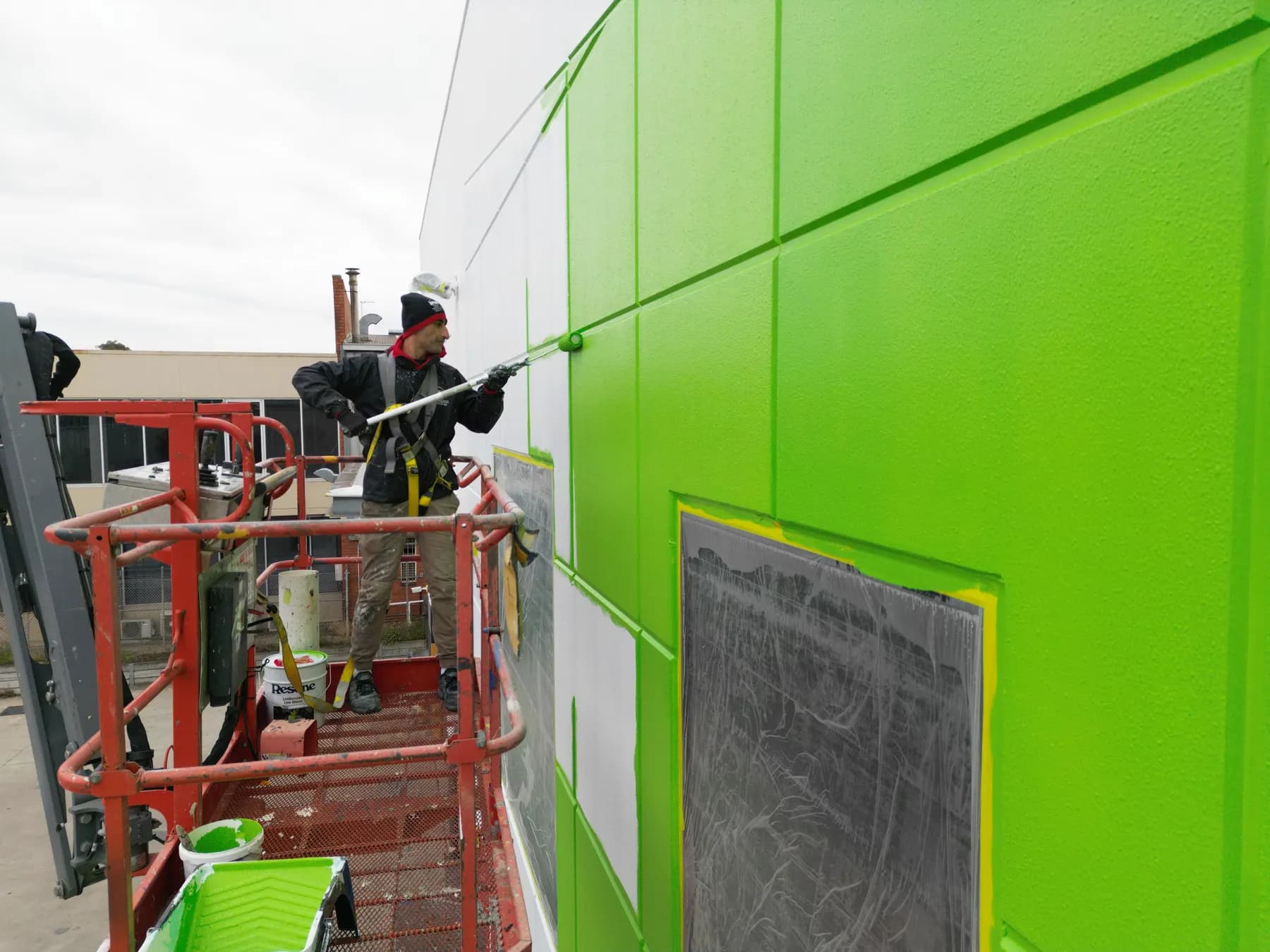
The scheme combined white block walls with wall panels in a bright brand green. The photographs show the two handled differently: the white blockwork sprayed with an airless spray gun, and the green rolled onto the panels from a scissor lift with an extension pole.
Rolling the brand green onto the wall panels from a scissor lift.
Two things make a brand colour read properly on a building this size. The colour has to be specified from the brand's own reference rather than matched by eye from a card, and checked on the actual wall in daylight before it goes everywhere. And each colour change needs a clean edge: on a panelled wall the panel joints give every colour a natural break line, and where there is no joint the line is masked.
Spraying the blockwork
Airless spraying puts paint into the texture of blockwork quickly and evenly, which a roller struggles to do across a large wall. The cost is overspray, so everything that is not being painted has to be covered first. At Noble Park, the air conditioning plant against the wall was wrapped in plastic sheeting before the spraying reached it.
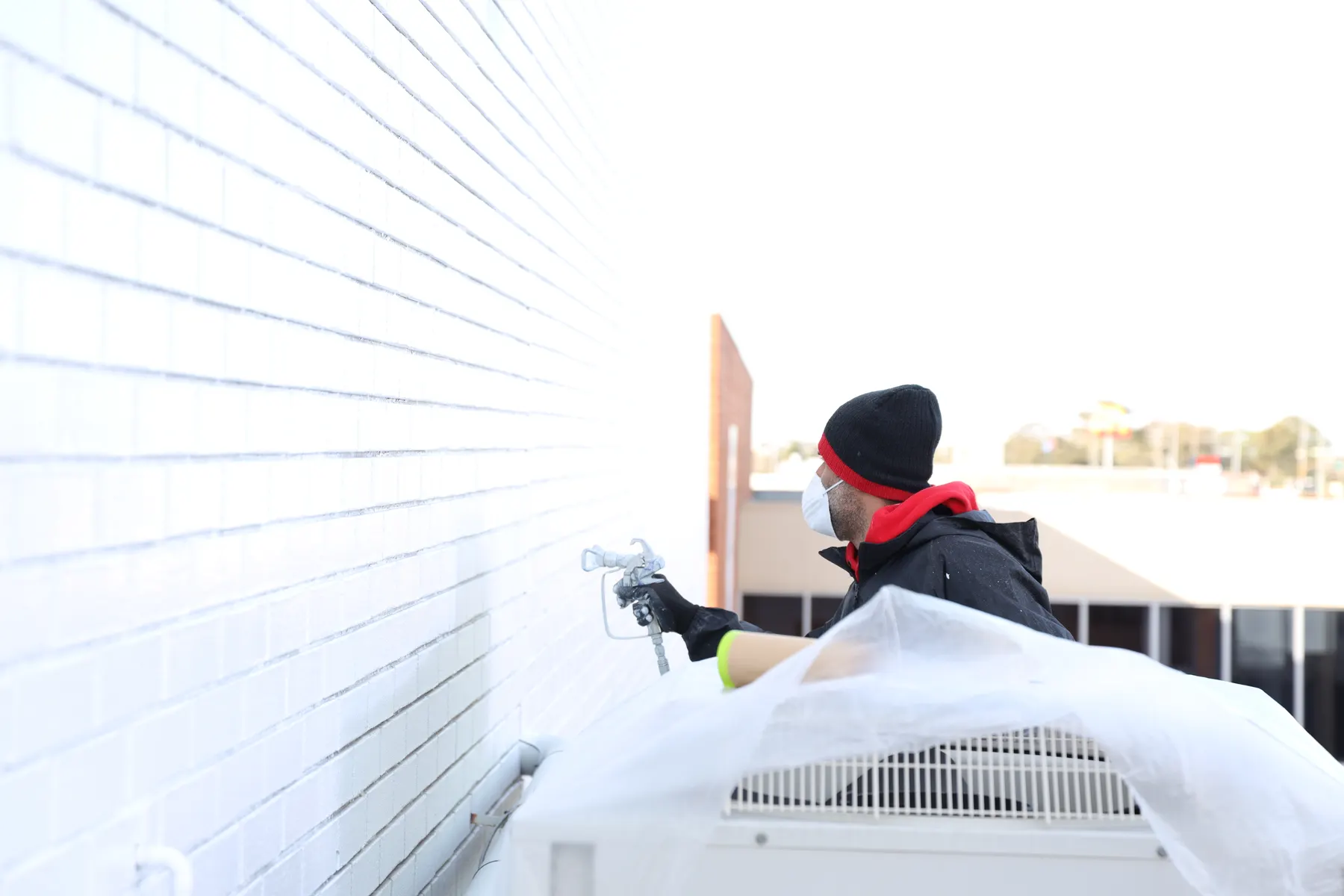 Spraying the blockwork, with the plant beside it wrapped against overspray.
The coating system
The walls received two coats of premium exterior paint, for depth of colour and added durability against sun, wind and rain. On an exterior, how much coating actually ends up on the wall — the film build — is a large part of what keeps the weather out, and two quotes with the same number of coats can still specify very different amounts of protection. Ask what system is being applied, not only how many coats.
Access: lifts, scaffolding and harnesses
The record lists three kinds of access, each matched to a part of the building: boom lifts for the high areas, scissor lifts for the mid-level walls, and scaffolding for the tight corners. All of it was carried out under OH&S practices by a licensed team.
The photographs show the crew harnessed on the scissor lift, harnesses sorted at the van before anyone went up, and two of the team up on the roof.
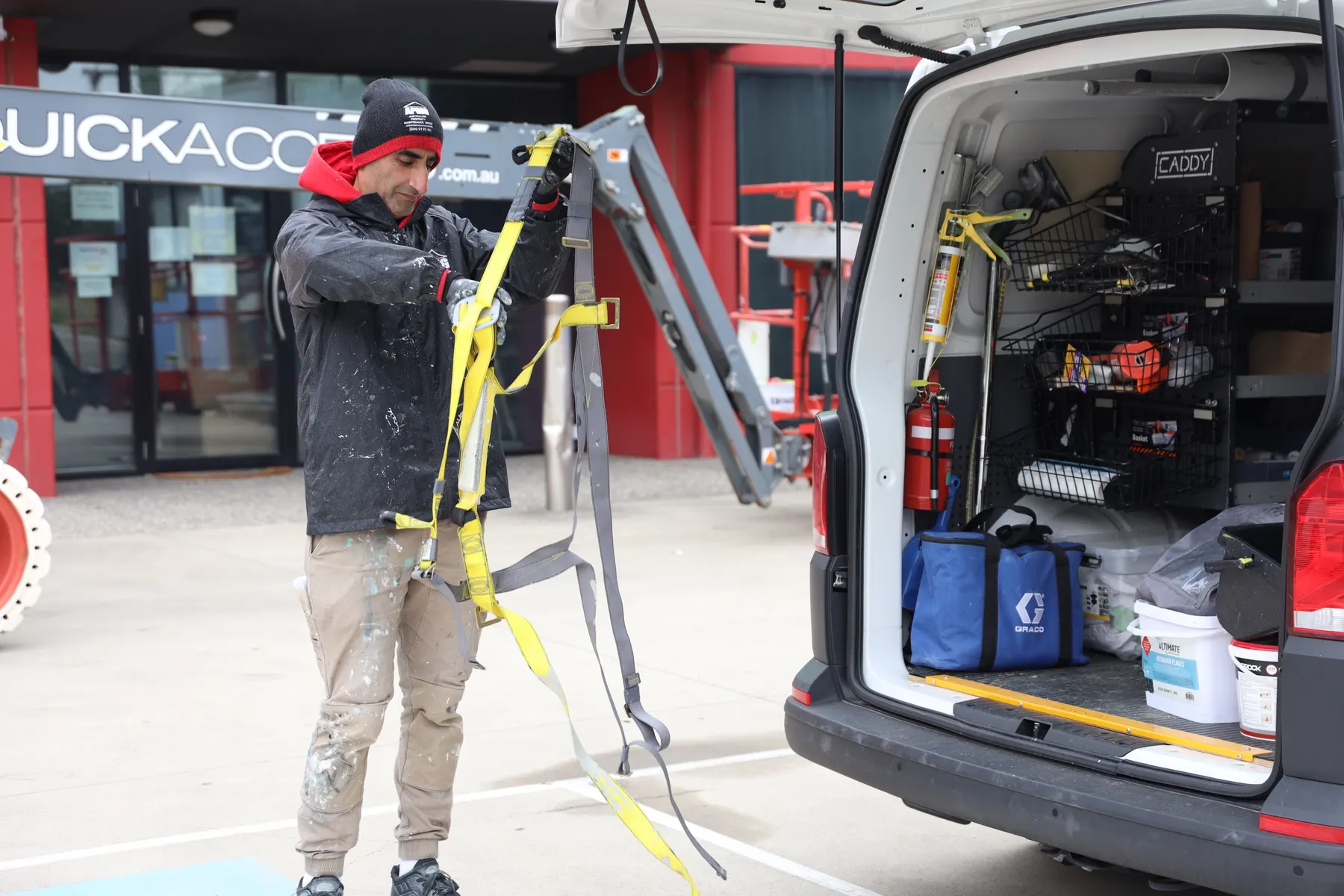 Harnesses are sorted at the van before anyone goes up.
Matching the access to each elevation, rather than putting the biggest machine against every wall, keeps more of the site clear for the factory's own traffic.
Working around a running factory
Production did not stop. The works were scheduled to avoid the factory's peak operational times, safe pedestrian and vehicle access was kept open throughout, and the programme was coordinated directly with the site managers.
In practice that means a large exterior is staged elevation by elevation, so one face is always clear for deliveries and dispatch, and each day's work is planned around when forklifts and trucks use each side of the building.
How a factory exterior repaint runs, step by step
- Site assessment before the quote. Substrates, existing coatings, access and operations are assessed on site.
- Paperwork before day one. Safe Work Method Statements, insurance certificates and a pre-start meeting with the site managers.
- Programme agreed. Which elevation is worked when, around production, deliveries and vehicle movement.
- Preparation. Washing, cleaning and repairs, so the coating has a sound base.
- Coating. The brand scheme applied in two coats, sprayed or rolled to suit each surface.
- Access per elevation. Boom lift, scissor lift or scaffold, chosen wall by wall.
- Handover. Each elevation cleaned up and returned to the site.
What to ask before a painter quotes your factory
| Ask | What a good answer sounds like |
|---|---|
| Will you identify the existing coating before specifying? | Yes — on site, before anything is priced. |
| What preparation is included? | Washing and repairs matched to what the assessment finds. |
| What system, and how many coats? | A named exterior system with the film build stated, not just a coat count. |
| How will you reach the high walls? | An access plan per elevation, not one machine for everything. |
| Can the factory keep running? | Yes, staged around production, deliveries and traffic. |
| What prequalification and warranty do you hold? | Contractor safety prequalification, insurance certificates and a written workmanship warranty. |
For the record, Commercial Painters attends every site before pricing it, holds Cm3 contractor OHS prequalification and Master Painters Australia membership, and as a Dulux Accredited Painter backs its work with a five-year workmanship warranty.
About this job
Commercial Painters is a commercial painting contractor based at 1 Turbo Drive, Bayswater North, working across Melbourne. The full record for this job is the Noble Park factory case study, factories and warehouses sit within our industrial painting work, and the full range of commercial painting services is set out separately. If you are comparing commercial painters in Melbourne for an industrial building, the questions above are a good place to start.
Common questions
Can a factory keep operating while its exterior is painted?
Generally, yes. At the Noble Park factory, works were scheduled to avoid peak operational times, safe pedestrian and vehicle access was kept open throughout, and the programme was coordinated directly with the site managers. Large exteriors are staged elevation by elevation so one face stays clear for operations.
What preparation does a factory exterior need before painting?
Washing and cleaning to remove dust, dirt and loose old coatings, repairs to render or other damage, and identification of the existing coating before anything is specified. Coating over an unidentified film is the most common reason an industrial repaint fails early.
How many coats does a factory exterior need?
The Noble Park factory received two coats of premium exterior paint, for depth of colour and durability against the weather. The right answer for another building depends on its substrate and existing coating, and quotes are better compared on the system and film build than on coat count alone.
How do painters reach the high walls of a factory?
With access matched to each part of the building. At Noble Park that meant boom lifts for the high areas, scissor lifts for the mid-level walls and scaffolding for tight corners, with the crew harnessed on the scissor lift.
Who painted the factory in Noble Park?
Commercial Painters, a Melbourne commercial painting contractor based in Bayswater North. The job was a full exterior repaint in the client's brand colours, with washing and render repairs first and two coats of premium exterior paint.